The Port Wing Mural Project

The Port Wing Historical Society is pleased to get the word out and to process donations for The Port Wing Mural Project. If you have not already seen them, take a look at the beautiful murals that are already in place on the old fire hall.


Welcome to the Port Wing Mural Project!

murals on the old fire hall:

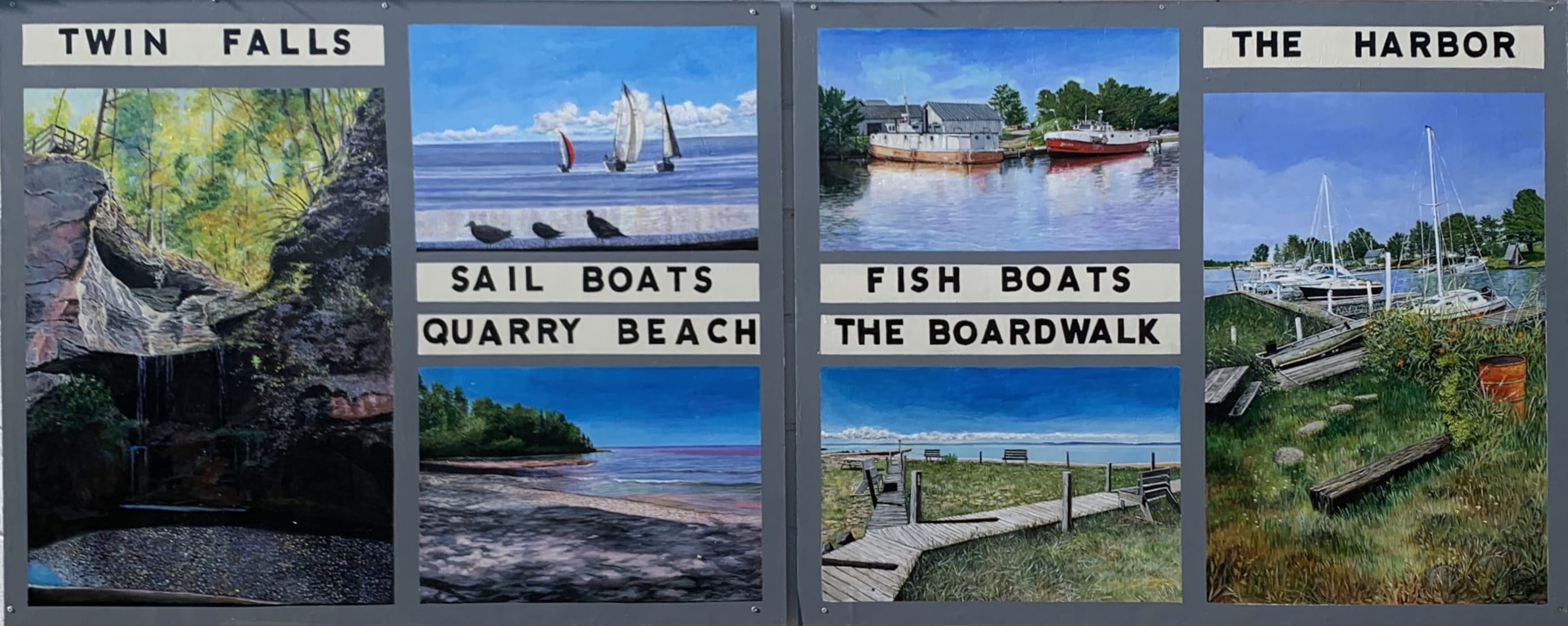
Check out the Old Fire Hall adjacent to the town park to view the murals that have been painted so far. These beautiful murals depict Port Wing’s rich South Shore history in great detail. Source photos for these detailed murals were taken from this website. Future murals are planned. Watch for events and announcements on the Port Wing Historical Society’s Facebook page and Heritage Hall News Letter and for postings around town.

The Port Wing Mural Project

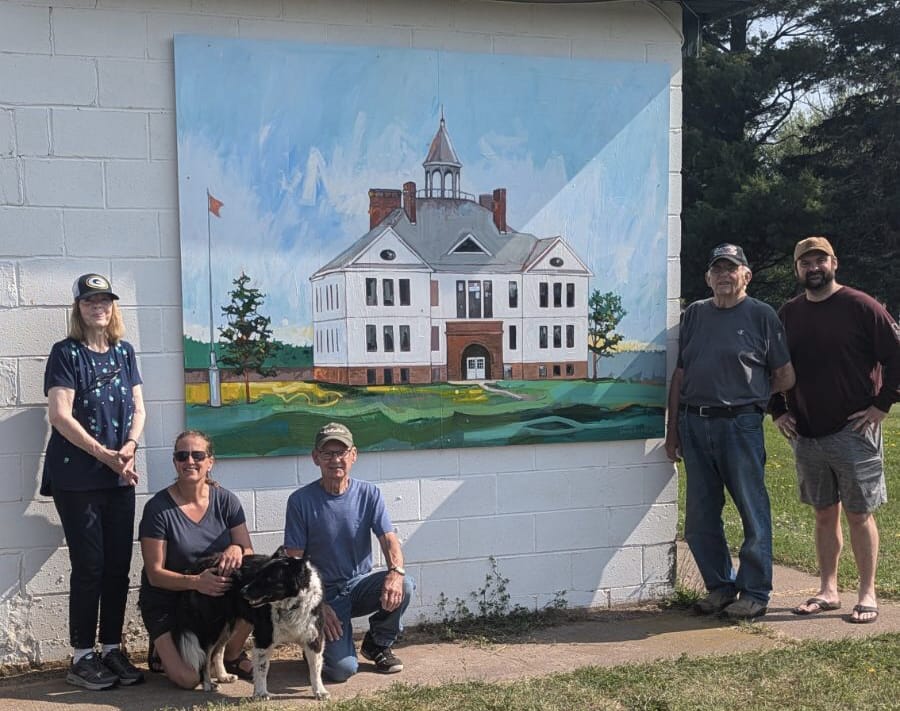
The artist of ‘The Big White School’ is Adam Swanson of Cloquet, MN. Artist Bob Holton painted all the other murals

Community Support

Many thanks to the Port Wing Historical Society for their help getting the word out and to make possible the collection of tax deductible donations through their 501(C)3 organization status. We would also like to thank the following community members and organizations for their work and in kind support:

Iron River Lumber
John Krauss
Andy Roebken
Tim Kresky
Alex Roebken

Sherwin Williams
Karen Stromme
Susie Krauss
Art Roebken

Sherie Kresky
Beth Hoagland
Olivia Roebken
Gary Holquist

Make the full mural project become a reality

The Port Wing Mural Project is the inspiration of descendants of the Lundgren family with additional community support. Future murals are planned. We are seeking grant funding but we will also need financial help from you to make them happen. Please consider a tax deductible donation to the project.

$25 – Mural Project Donation

Processing ...


$50 – Mural Project Donation

Processing ...


$100 – Mural Project Donation

Processing ...


Donate the Amount of Your Choosing

Processing ...


Or Make Your Check Payable To:
Port Wing Historical Society with a memo designating The Mural Project
Mail to:
Marjorie Ogren, Secretary
P. O. Box 28
Port Wing, WI 54865

31. St. Mary’s Catholic Church
Former St. Marys Church

Port Wing had a number of Irish Catholic families and they soon formed a congregation. Father Patrick  Dayras came from Iron River to offer mass once a month. Largely through the efforts of James Daly,  with help from Michael Hopkins of Orienta, money and material donations were collected. With  volunteer labor (as was true with all Port Wing churches), St. Mary’s Catholic Church was completed in  1898. The church was used until recent years, becoming first a pottery shop and residence and now a  quilt shop is doing business there.

30. The Swedish Mission Church

The small yellow church you see on the corner was built in 1920 by the Swedish Mission congregation.  This congregation had formally incorporated back in 1895 but had been holding services in homes and  in the Presbyterian Church building. The Reverend Skogsbergh was pastor at the time. The building is  now the Hoth-Lee Art Gallery.

29. The Telephone Company

In 1901, Carl Hogfeldt bought two telephones, installing one where he lived in the village, the other in  the home of his friend, Axel Johnson, in the Flagg River Valley. Interested businessmen could  immediately see the advantages.

On April 2, 1902, the Port Wing Town Board appropriated $1000 to construct a phone line between  Port Wing and Iron River. The Port Wing Telephone Company was organized in September 1903, with  Carl Hogfeldt as general manager. By 1906 there were 75 subscribers. The switchboard was in the  Widow Augusta Nelson’s home where Carl boarded. In 1910, after the Hogfeldt’s purchased the white  house across the street (which was the first Lutheran parsonage), its front room became the Telephone  Company office. In 1952 the Port Wing Telephone Company merged with Chequamegon Telephone of Cable.

28. Lundvall’s Feed Mill

As you look across the church yard south of the church, notice the red barn building on the alley. It has  a fascinating history and recently has been carefully restored by its owners. Oscar Bergstrom built his  home, located where the current church yard is now, as well as the barn in about 1903. Besides using  the barn for his team, he was also the village shoemaker. In 1918 the Bergstroms traded land with  John Alfred Lundvall and moved out to the Flagg River Valley. Oscar continued using the front room of  his former house for the shoe repair shop. Al Lundvall, a single man, did not mind having a shoe shop  in his front room.

Al worked in the sawmill, did contract threshing and eventually, at the age of 55, started a feed mill in  the red building. He ran the mill for many years. Quite a few Port Wing oldsters can remember being  sent to the mill with a sack of corn and waiting around while Al ground it into chicken feed.

27. First Lutheran Church

The founders of Port Wing were a deeply religious Swedish group, so one of their first priorities was to  establish a Swedish Lutheran congregation. The first church service was held in 1893 in the Okerstrom  home. It was conducted by Rev. J. D. Nelsenius of Ashland. In 1896 the congregation built this church  on the corner of Washington Avenue and Sixth Street. Now modernized and somewhat enlarged, it is  still being used today, 122 years later.

26. Ogren’s Store

In 1895, Swan S. Ogren, longtime prominent Port Wing businessman, built a dry goods store on this  site. In 1907 the building was raised, and a basement was put underneath. It became a full general  store carrying groceries, hardware, feed, dry goods, and gas. When in 1920 the store was enlarged to  its present size, S. S. Ogren continued the business throughout his lifetime, with his son, Leonard  eventually taking over its management. In 1971 it was sold to Milton and Esther Ollenberger who ran  it as a grocery store for a few years until they, in turn, sold it to Eric and Janet Johnson. The business  has been moved to the south side of Highway 13 and this building is now a residence.

25. Roy Okerstrom’s House

This fine home was built by T. N. Okerstrom for his son Roy. The finest wood from the mill was saved  for this home. Somewhat as an incentive, Okerstrom promised Roy he would build him a house if, following World War I, Roy would return to Port Wing, marry and go into business with his father. Roy Okerstrom became the Wisconsin Hydro Electric Company manager and went on to a long career with Lake Superior District Power Company in Ashland. It is still a private residence.

24. The Okerstrom Office Building

In 1895, T. N. Okerstrom built a building on the corner of Washington Avenue and Fourth Street. It  housed his real estate business and lumbering office, plus his residence. Some years later an addition  was added to the south side of the building. T. N. Okerstrom passed away in 1926, but his wife Mary  continued to make Port Wing her home. In her later years the building was made into several  apartments with Mary Okerstrom keeping the rear apartment for herself. Quite a few young Port Wing couples began married life in one of those apartments.

23. The Wigwam Hotel

The Wigwam was built in 1919 by T. N. Okerstrom as a dining hall for his mill workers. A few years  later he used it to house the men who were building the new Orienta Power Dam. It was operated as  the Wigwam Hotel after it had been sold to Robert Swenson in 1933. The building is now a private  residence.

22. The First State Bank of Port Wing

In 1911, the First State Bank of Port Wing was chartered with Swan S. Ogren as President, John H.  Klovstad as Vice President, J. A. Nelson as Cashier and W. T. Gruver as Assistant Cashier. It was first  located in the Austin Hotel building, but after two more moves it opened its doors at its present  location. The Port Wing Bank was finished in 1918. Now known as Security State Bank, it is the oldest continuously existing business in Port Wing.

21. The Lundgren Block

Once the largest, most modern business in Port Wing, the Block was built by Al Lundgren and Son in  1921. They operated several different businesses in the building—a barbershop in the basement, and  a grocery and then a drug store and ice cream parlor on the first floor. Toward the back of the building  was an entertainment center in which he offered silent movies and theater productions. In 1933,  Lundgren started the Globe Tavern in the theater area. He offered public dances and sold food. The  building was eventually sold to Everett’s Fisheries who used it as a processing, freezing plant and  storage until their new facility was built on Sunnyside Lane.

20. Dr. Nils J.G. Dahlstedt’s Drug Store

Dr. Dahlstedt established his office and a drug store on the site of the old Solberg Saloon in about  1902. As he also became postmaster that year, the Post Office was moved into his building as well.  Unfortunately, Dr. Dahlstedt passed away a few years later in 1909, but the property remained in his  estate. His son Carl later became postmaster and the Post Office stayed in that building for many  years. The building now is the location of Trout Run Gallery.

19. The Bentson Hotel

At the south end of the block was the site of H.M. Bentson’s hotel and saloon. Originally there was a  store on that corner, but in 1901 Bentson built the Star Hotel, later calling it the Scandinavian House.  Just to the north of the hotel stood the saloon, and an elevated board sidewalk stood in front of them  both. This was a popular rooming house for many years and was still standing during the 1950’s.

18. The Austin Hotel

Port Wing’s largest hotel and the only three-story building in town stood on the southwest corner of  Washington Avenue and Second (School) Street. The Austin, also known as the Martin House, was  built in 1896 by T.F. MacMiller of Iron River. Like his other businesses, MacMiller placed the Austin  under local management. William Austin, William M. McCardle, William C. Allan and Charles Braff all  took a turn at running the Austin Hotel and Saloon, which was an addition to the building on the south  side. During that time, the Post Office was in the hotel and fore-named gentlemen each served as  postmaster for a year.

The Austin Hotel building was finally purchased by O.T. Bagstad who opened a store in it. In 1927,  Bagstad had the old hotel building torn down and a modern IGA Grocery Store, with a residence above,  was built on this site. That building was destroyed by fire in 1956.

17. Businesses along North Washington

There were three more store buildings in this same block, south of the Company Store. Closest to it, E.  Johnson had a candy store, called a confectionery in those days. Next door John Patry had a store and residence, and to the south of him Hokan Nilson also owned a small store.

16. Moore Kepple Company Store

Moore Kepple Lumber built its Company Store and office on the southeast corner of Washington  Avenue and Second (School) Street in 1895. In those days, company employees could charge items  and the amount due would be subtracted from their next paychecks. In 1906 it was taken over by W.T.  Gruver and became a hardware store. In 1914 it was sold to Danielson and Lundgren. This business  later became Port Wing Hardware owned by Samuelson and Buchholz. The building has been gone for  many years.

15. LakeView Hall

One Port Wing building that indeed had a very colorful past was LakeView Hall. Built in the first year or  so of the village’s existence, it was sometimes called LakeView Hall or LakeView Hotel and had an  addition attached to it called Callen’s Hall. It was a saloon, a rooming house, a meeting place and a  dance hall. In the early years it was owned by John Nyquist. From 1901 until the old schoolhouse  became available for the Town Hall, the new Town Board held their meetings in Callen’s Hall. In 1910,  it became the Modern Woodmen of America Hall. Some years later the Evangelical Lutheran  congregation bought it and met there. Finally it became a private residence of the Norman Johnson  family.

14. Klovstad’s Store

John Klovstad purchased property here in 1896 and the following year built his general store with his  residence above. Over time he enlarged his business to include farm machinery and real estate,  among other things. He added on to building and eventually moved his family to a home across Lake  Avenue.

13. Gidmark’s Store

In 1898 Gidmark and Johnson built a large new store building on the northeast corner of Washington  and Second Street. (School Street) This successful business grew and in 1910 John Gidmark bought out  his partner and bought the MacMiller building next door, expanding his store into it. The store was a  Port Wing landmark until it burned in 1922 and was not rebuilt.

12. MacMiller’s General Store

T. F. MacMiller of Iron River was quick to realize the business potential in the new town on the lake.  He was already a successful entrepreneur with money to invest. In 1895 MacMiller build a General  Store at this site on Washington Avenue. Possibly he moved what remained of the McConnell building,  we don’t know. He hired local managers to run all of his local operations, including this one. In 1901  the store was converted into a saloon and rented to James “Whack” Pierce.

11. McConnell’s Store and Post Office

This was the site of what were probably Port Wing’s first businesses—William McConnell’s General  Store and Post Office. At that time the appointed postmasters had to provide his own boxes and stock  his own postal service. Usually that was done in conjunction with a store. The McConnell Store was  built in late 1892 or early 1893. Ebery Manufacturing, who put in the first mill, may have been a  partner. It was in the center of Block 4. Ebery got caught in the financial panic of 1894 and sold out to  Moore Kepple. McConnell’s General Store must have burned a few years later. There is no evidence
of it now.

Across the street, George A. Howard had a restaurant and real estate office. He was a business partner  of T. N. Okerstrom and together they had platted and recorded the village of Port Wing in February  1893.

10. The Harbor

Once, this channel was lined with huge stacks of lumber waiting to be shipped out. A high tramway  extended from the mill site out to the present breakwater wall. Boats from all around the Great Lakes  docked and loaded here. On the south side of the harbor channel stood the Booth Fisheries Office and  Warehouse, and the piers where the Steamer America and other excursion and mail carrying ships  docked. Commercial fishing began in Port Wing just after the beginning of the twentieth century. Net  and fish sheds dotted both sides of the harbor. Though the timber was gone, and lake travel declined  quickly with the advent of automobiles and better highways, commercial fishing prospered through the  mid-twentieth century. Now that has largely given way to sport fishing and pleasure boating. There  are only two commercial fishing operations working out of the harbor today.

Many of the buildings you see along the water have been there since the 1930’s and now serve as a  colorful reminder of our past.

The first harbor improvements were made in 1895 with T. N. Okerstrom putting up most of the money.  In 1898 Congress designated Port Wing as a federal harbor, and in 1900 approved an appropriation of  $25,000 for improvements (docks, piers, dredging, etc.)

9. The Big Mill

The heartbeat of Port Wing came from the Big Mill. T. N. Okerstrom knew this was the perfect spot for a major lumber operation, but he lacked the working capital to build it himself. In 1893 Ebery  Manufacturing put in the first steam powered sawmill on the north side of Bibon Lake. Less than two  years later Moore Kepple Lumber Company of Warren, Pennsylvania, bought the mill site and erected  a large band saw that had the capacity of sawing 70,000 board feet in a 10-hour workday. John Calkins  was general manager. The mill was fed logs from about two dozen lumber camps scattered  throughout the region. Those logs were flumed to the mill through waterways—the Flagg River, Bibon  Lake, Larson and Kinney Creeks—and boomed into the harbor through Lake Superior. In a matter of  ten years the forests were about gone. Millions of board feet of lumber had been shipped out on lake  steamers to all parts of the Midwest and beyond.

In 1906 Moore Kepple sold out to T. N. and John Okerstrom, who continued the operation until  December 1914, when the mill burned. After much debate, T. N. rebuilt the mill but with a circular saw  that had a somewhat smaller capacity. The timber was gone, so in the fall of 1924 the mill closed its  doors for good. The following March, the machinery was sold and moved to Butternut, Wisconsin.

8. Early Businesses in Block 7

Most of the earliest businesses in Port Wing were along Washington Avenue in the first blocks closest to Lake Superior. Just north of Greenwood’s stood Neal Cameron’s Boarding House. It was also built in 1893. Next to that to the north was the Brace Building, a store owned by Fred Brace. Beyond that was a building owned by August Sahlborg and later used as a warehouse by Gidmark and Johnson.

7. Greenwood’s Livery Stable

Charlie Greenwood was one of Port Wing’s earliest citizens and an enterprising fellow from the start. In 1893 he built the first hotel and saloon on the northwest corner of Washington Avenue and Second Street. He rented rooms to millworkers and travelers and served the lumberjack trade in his saloon. No doubt having had enough of drunken brawls, in 1902 he turned it over to Louis Olson and concentrated on his other business, a livery stable and blacksmith shop which he had built on the back half of his lots. Charlie kept four teams of horses and eight wagons for hire. In the 1920’s, when automobiles began to replace the horse, he turned his livery stable into a mechanic’s garage.

6. Moore Kepple Manager’s Residence

In about 1901, Moore Kepple Lumber Company of Warren, Pennsylvania (owners of the big sawmill) built a residence for its local manager and to house visiting officials who might be here on business. Moore Kepple ceased operations and sold the mill and accompanying land to T. N. and John Okerstrom. John Okerstrom made the manager’s house into his own home. It is still a private residence.

5. The Old Jail

In the early years, law enforcement was strictly a local matter and usually one leading citizen was a Deputy Sheriff. Charles Greenwood maintained the law in the 1890’s, followed by James Daly. In 1896, the stout wooden jailhouse, now standing behind the Heritage Hall Museum, was built on this site. For the most part it housed rowdy drunks who had been kicked out of one of the many saloons, but occasionally Port Wing did have some serious crimes. Prisoners could be held there before being transported to Washburn.

4. The Union Church

In 1895, Port Wing’s first church building was constructed by the managers of Moore, Kepple Lumber Company. This church later affiliated as a Presbyterian Church. Over the years several different congregations met there before they built churches of their own. In the 1950’s, First Lutheran Church acquired the building to use as a library and fellowship hall. The building has been gone for some time.

3. The Old Town Hall

In 1904, after the Big School was finished and classes had moved into it, the first schoolhouse built in 1894 was turned into a Town Hall. It served the community as an office and meeting place until the present Town Hall was built as a WPA project in 1934. At that time the old building was dismantled, and the lumber was used in building the new one.

2. The Creamery

Two one-room schoolhouses stood side-by-side on this site. The were built by the Town of Bayfield— the first in 1894 and the second, just to the south, in 1898. That second schoolhouse became the Port Wing Co-operative Creamery when the businesses incorporated in 1906. High quality butter was produced here under Francis Buchholz, butter maker. Following him, Oscar Carlson was butter maker for many years. In 1920 the Co-op expanded and build the cement block building farther south on Grand Avenue.

1. Big White School
School under construction - 1902
School under construction, 1902

As soon as the new Town of Port Wing was established, plans got underway to replace two single-room schoolhouses and several rural schools with one large school building that would serve all children in the district. T. N. Okerstrom was said to have been particularly anxious to get a new school built while there was still prime lumber in the area for building materials. An innovative plan was put into effect for “busing” all rural students into the village to attend classes in the new big school. Port Wing is credited with being the first consolidated school district in the State of Wisconsin that provided free transportation for all the students at taxpayer expense. The large, white framed three-story school with brownstone basement and trim was completed and ready for occupancy in January 1903. It was a state-graded school. At first only the five rooms on the first floor were used, but in 1912 high school classes were added, utilizing the second floor. The class of 1917 was the first to graduate from Port Wing High School The big white school stood proudly as a Port Wing landmark until 1979. The school’s belfry remains on the site, now the School Memorial Park. More on Port Wing Schools